
News
World Egg Day: Why Your Everyday Protein Could Cost More This Winter


From rising poultry feed costs to growing demand for maize, here’s how changes in the energy and agriculture sectors could affect your grocery budget.
Eggs are among the simplest ways to add protein to your daily diet without spending too much. But when their prices rise, even a small increase can add up for households that buy them regularly.
As India celebrates World Egg Day on October 9, 2026, egg prices are also drawing attention to a bigger question: how can changes in industries far removed from our kitchens affect everyday expenses?
A September 2026 report by India Today, citing a LocalCircles survey of more than 67,000 consumer responses across 287 districts, found that 62% of respondents reported egg price increases of 10% to 50% or more over the previous six months.
So, what is driving these increases, and what could they mean for your wallet?
Why are egg prices rising?
1. The maize and ethanol connection
One of the key ingredients in poultry feed is maize, which provides energy to chickens. However, maize is also used to produce ethanol, a biofuel blended with petrol in India.
As demand for ethanol grows, more maize may be directed towards fuel production. This creates competition between industries that need the same agricultural commodity, including poultry farmers who depend on it to feed their birds.
When maize becomes more expensive, the cost of poultry feed can rise. Farmers may then pass on some of these additional expenses through higher egg prices.
2. Rising poultry feed costs
Maize is not the only ingredient used in poultry feed. Soybean meal and other nutrients are also important for poultry health and egg production.
A September 2026 report by India Today noted that poultry feed costs had risen by around 15% year-on-year in July. Higher input costs can squeeze farmers’ margins and contribute to higher prices for consumers.
Weather conditions can add to the pressure. Heat stress can affect poultry productivity, while disease outbreaks and supply disruptions can increase production costs.
3. Could winter make eggs more expensive?
Egg consumption often increases during colder months. If demand rises faster than supply, prices may face additional pressure.
However, further price increases are not guaranteed. Actual prices will depend on feed costs, poultry production, local supply and seasonal demand.
What Does This Mean For Your Monthly Budget?
A small increase in the price of an egg may not seem significant, but regular purchases can make a difference over a month.
For example, if you eat two eggs daily, you consume around 60 eggs in 30 days. If the price per egg rises by ₹2, that means an additional ₹120 a month. For a household consuming four eggs daily, the extra expense would be ₹240.
These are illustrative calculations, not estimates of the current price increase.
The Bigger Picture
India’s ethanol-blending programme aims to reduce dependence on conventional petrol. However, when crops such as maize are used for both fuel and animal feed, changes in demand can affect production costs across industries.
Ethanol production is not the only reason egg prices change. Weather, feed costs, supply and consumer demand all play a role.
This World Egg Day, the takeaway is simple: everyday expenses are connected to the wider economy. Understanding these connections can help you make sense of rising grocery bills and manage your household budget better.


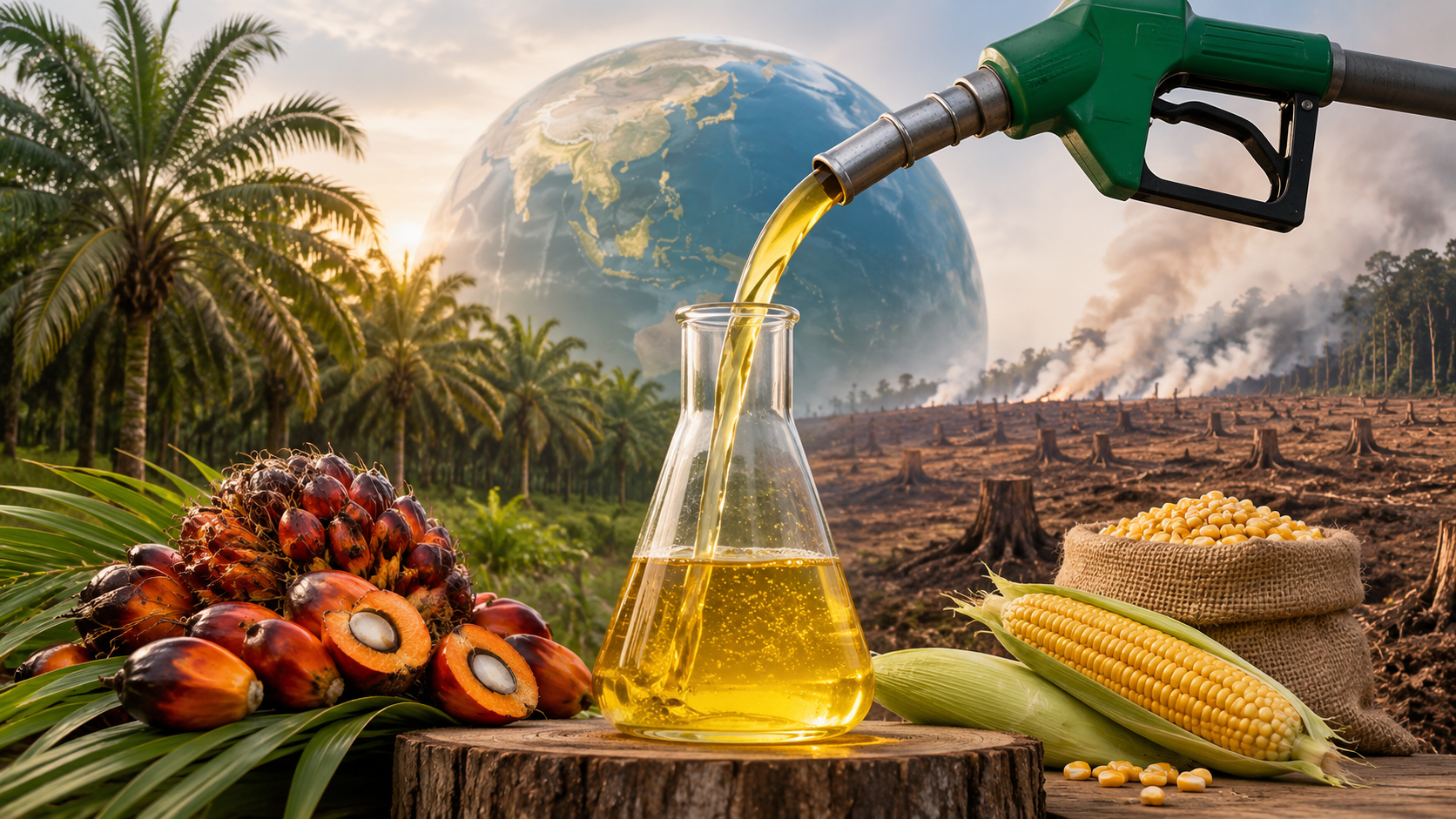
The shift towards cleaner energy is often seen as a win for the environment. Countries are increasingly turning to biofuels to reduce their dependence on imported crude oil. But what happens when the push for cleaner fuel starts putting pressure on food production, agricultural land and forests?
Indonesia and India offer two interesting examples of how energy policies can have consequences beyond the fuel tank.
Indonesia Is Getting Paid to Save Its Forests
In 2022, Norway and Indonesia signed an agreement under which Norway promised to pay Indonesia up to $1 billion for reducing emissions caused by deforestation and forest degradation. The agreed rate was $5 for every tonne of emissions avoided.
Now, Indonesia is set to receive around $90 million after reducing these emissions by approximately 270 million tonnes between 2020 and 2023.
However, there is a contradiction. While Indonesia is receiving money for protecting its forests, forest fires have continued to damage its national parks. By September 2026, more than 70,000 hectares of land across 47 national parks had reportedly burned.
One of the reasons behind this challenge is palm oil.
Why Palm Oil Could Become an Environmental Problem
Indonesia is the world’s largest producer of palm oil. As demand for this commodity grows, plantation owners have an incentive to expand production, which can mean clearing more land.
Interestingly, palm oil prices also influence deforestation. A 2022 study found that a 1% fall in palm oil prices was associated with a 0.68% decline in forest loss. Lower prices can reduce the incentive to clear additional land for plantations.
But Indonesia’s energy policy could change this equation.
The country has introduced a B50 biodiesel mandate, which requires diesel to contain 50% biodiesel, largely made from palm oil. The objective is to reduce dependence on imported fossil fuels and improve energy security.
The challenge is that Indonesia already consumes a significant portion of its palm oil domestically. In 2024, around 53% of its total production was used within the country, even under the earlier B35 blending requirement.
With B50, domestic demand could increase further. This could support palm oil prices and encourage plantation owners to expand production.
Indonesia has already doubled its oil palm plantation area between 2001 and 2019, taking it to approximately 16 million hectares. Estimates suggest that achieving the B50 target by 2030 could require converting another 8.5 million hectares of land.
The Problem With Turning Forests Into Fuel
One of the biggest concerns is the possible conversion of peatlands into palm oil plantations.
Peatlands are areas of waterlogged soil that store enormous amounts of carbon accumulated over thousands of years. They act as natural carbon sinks and play an important role in controlling greenhouse gas emissions.
However, oil palm trees cannot grow well in waterlogged conditions. To make these areas suitable for plantations, the land is drained through canals. This exposes the stored organic matter to oxygen, releasing carbon dioxide into the atmosphere.
Drained peatlands also become more vulnerable to fires.
This creates a problem for biodiesel. While biodiesel is intended to reduce emissions by replacing fossil fuels, clearing forests and draining peatlands to produce it can create a significant carbon footprint.
A 2008 study published in Science estimated that palm biodiesel produced from cleared tropical rainforest could take around 86 years to repay its carbon debt. If the plantation replaces tropical peatland rainforest, that period could stretch to approximately 420 years.
In other words, a fuel designed to be cleaner could take centuries to deliver its climate benefits.
India’s Ethanol Push Has Its Own Set of Challenges
The story is not very different in India, although the biofuel in focus is ethanol rather than palm-based biodiesel.
India has been promoting ethanol blending to reduce its dependence on imported crude oil. However, as demand for ethanol has increased, so has the demand for the crops used to produce it.
Ethanol demand has grown from 1.7 billion litres in 2019-20 to a projected 12 billion litres in 2025-26.
Sugarcane and corn have increasingly become important raw materials. Corn, in particular, has seen its contribution to India’s ethanol blending programme rise from almost nothing in 2021-22 to around 37% in 2025-26.
But corn is not used only for fuel. It is also a key ingredient in poultry feed.
As ethanol manufacturers compete with poultry farmers for the same crop, feed costs can increase. This eventually puts pressure on the prices of eggs and chicken.
There is another concern. Farmers may prefer growing crops that offer better returns. The Economic Survey 2025-26 has flagged a shift towards corn and away from pulses and oilseeds.
If this trend continues, India could become even more dependent on imported edible oils.
How India’s and Indonesia’s Policies Are Connected
This is where the two countries’ stories come together.
India is the largest export market for Indonesian palm oil. If Indian farmers increasingly move towards growing corn instead of oilseeds, India may need to import more edible oils.
At the same time, Indonesia’s growing domestic demand for palm oil for biodiesel could leave less supply available for exports.
Both countries are trying to reduce their dependence on imported crude oil. But the consequences could show up elsewhere.
For India, it could mean higher food prices and greater dependence on edible oil imports. For Indonesia, it could mean more pressure on forests, peatlands and carbon emissions.
The government has already begun adjusting its ethanol policy. For 2026-27, oil companies have been asked to stop procuring ethanol made from sugarcane juice, sugar syrup and raw sugar. The additional incentive for corn-based ethanol has also been reduced from ₹5.79 to ₹2.79 per litre.
However, reducing demand for one crop could simply shift the pressure to another.
Can Countries Make Biofuels More Sustainable?
There are ways to reduce these unintended consequences.
For Indonesia, improving productivity on existing plantations could be a better alternative to clearing additional land. Smallholders manage around a third of the country’s oil palm plantation area. Better-quality seedlings and improved farming practices could help increase yields without expanding plantations.
Governments could also make biofuel blending targets more flexible. Instead of following fixed targets regardless of crop availability and prices, blending requirements could be adjusted when agricultural commodities become scarce or expensive.
Another option is to explore alternatives beyond food crops. Used cooking oil, agricultural waste and crop residues can be used to produce biofuels without creating the same pressure on farmland.
The Bigger Picture: Energy Security Should Not Come at the Cost of Food Security
The move towards cleaner energy is important, but the way countries approach it matters just as much.
Reducing dependence on imported oil is a valid economic and strategic goal. However, if achieving it makes food more expensive, increases edible oil imports or leads to the destruction of forests, the benefits become harder to justify.
There is also an economic question worth considering. Plantations generate revenue through every harvest, while forests provide benefits such as carbon storage, water conservation and protection against fires that are not always reflected in their financial value.
Until protecting these natural resources becomes economically rewarding too, forests will continue to compete with more profitable uses of land.

A family business can take generations to build. But without clear documentation, deciding who owns what can become a challenge of its own.
India’s business families are increasingly bringing an important question into focus: when wealth is built across generations, how do you ensure it is divided fairly?
The latest developments within the TVS family offer an interesting perspective.
Lakshmi Venu, daughter of TVS Motor chairman emeritus Venu Srinivasan, has formally sought the partition of joint family assets held within her father’s branch of the family. In a notice to her father, she has sought a fair and lawful division, asserting her rights under the Hindu Succession Act, 1956, as amended in 2005.
The assets in question include family interests held through the VS Trust and other holding structures, covering interests in TVS Holdings, TVS Motor Company, TVS Credit Services and Sundaram-Clayton.
At the centre of the issue is a distinction between the larger TVS family arrangement of 2020 and the subsequent arrangements within the Venu Srinivasan family. While the broader family restructuring was implemented, Lakshmi maintains that the economic interests within her immediate family were never formally partitioned. Venu Srinivasan and his son Sudarshan, on the other hand, have maintained that the 2024 family arrangement constitutes a settlement.
The matter highlights an important aspect of succession planning: dividing responsibilities is not necessarily the same as dividing ownership.
Why documentation matters
In family-run businesses, decisions about ownership, management and inheritance can often overlap. One family member may manage a company, another may hold shares, while other assets may sit within trusts or separate holding entities.
Without clear documentation, these arrangements can become difficult to interpret, particularly when the next generation begins taking on larger responsibilities.
A well-documented family settlement can help establish who owns which assets, how shares are distributed, who has management responsibilities and what happens when ownership changes. It can also help distinguish personal wealth from business assets and clarify the role of trusts, holding companies and other structures.
The importance of getting the paperwork right
India’s Hindu Succession Act, particularly Section 6 following the 2005 amendment, recognises daughters as coparceners by birth in Hindu joint families governed by Mitakshara law, giving them the same rights and responsibilities as sons in qualifying coparcenary property.
This makes it important for families to understand the nature of their assets and document their arrangements accordingly. Not every family asset automatically falls under the same inheritance rules. Self-acquired property, ancestral property, company shares and assets held through trusts can involve different legal considerations.
For business families, succession planning is therefore not just about choosing the next leader. It is also about creating clarity around ownership, rights and responsibilities.
Because building an empire may take decades, but ensuring the next generation inherits it without confusion requires planning much earlier.

You spend years building wealth, buying property, investing and creating financial security for your family. But have you decided what happens to it when you are no longer around?
It is a question many people postpone. Making a Will is often associated with old age or enormous fortunes. But estate planning is not just for billionaires. Anyone who owns assets, investments or property can benefit from having one.
And the stories of some of India’s biggest business families show why.
When an empire has no clear instructions
Take the example of Dhirubhai Ambani, the founder of Reliance Industries.
When he passed away in July 2002, he did not leave a Will. His estate was subsequently dealt with through a Deed of Release signed by his wife Kokilaben, sons Mukesh and Anil, and daughters Nina and Dipti. The document recorded that Dhirubhai had died intestate, meaning without leaving a Will.
In the years that followed, differences between Mukesh and Anil over control of the Reliance business became a major corporate story. The family eventually reached a business division in 2005, with Kokilaben playing a key role in the settlement.
While the absence of a Will was not the sole reason for the brothers’ differences, the episode highlighted how complicated wealth distribution and business succession can become without clear arrangements.
Ratan Tata: A Will that reflected personal choices
A very different example emerged after Ratan Tata’s death in October 2024.
His Will attracted considerable attention because of the way he chose to distribute his personal wealth. Reports indicated that a significant portion of his estate was earmarked for charitable causes through the Ratan Tata Endowment Foundation and Trust.
His Will also made provisions for family members, close associates and people who had been part of his personal life. Even his beloved German Shepherd, Tito, was remembered through arrangements for his care.
The Will demonstrated that estate planning is not simply about dividing wealth among immediate family members. It allows individuals to decide which causes, people and responsibilities they want their wealth to support.
It is also important to distinguish between personal inheritance and corporate succession. A Will can distribute assets owned by an individual, but it does not automatically decide who will run an entire business group.
So, what exactly does a Will do?
A Will is a legal document that records how a person wants their assets distributed after their death. It can cover property, bank deposits, investments, shares and other assets owned by the individual.
It allows a person to:
- Decide who inherits what: Specify beneficiaries and the assets they should receive.
- Reduce confusion: Give family members a clear record of the person’s wishes.
- Appoint an executor: Identify someone responsible for carrying out the instructions in the Will.
- Make provisions beyond family: Leave assets to charities, friends or other individuals.
- Plan for dependants: Include arrangements for minor children and other dependants.
What happens if you don’t have a Will?
If someone dies without a valid Will, they are said to have died intestate. Their estate is then distributed according to the succession laws applicable to them.
For example, the Hindu Succession Act governs intestate succession for Hindus, Buddhists, Jains and Sikhs, while other communities may be governed by different personal laws.
This means the distribution may not necessarily reflect what the individual would have wanted.
A little planning today can prevent a lot of confusion tomorrow
Making a Will does not mean you are expecting the worst. It means you are taking responsibility for the wealth you have built and the people who may depend on it.
It is also important to review your Will as your financial circumstances change, keep asset records updated and ensure that the document is properly executed and witnessed under applicable law.
-
 News2 months ago
SC Says No Stay On New UPI Charges Above ₹2,000
-
 Podcast1 year ago
Nitin Jain: From IIT to Investment Titan, Managing ₹60,000 Crore AUM
-
 News2 months ago
NSE Makes Long-Awaited Market Debut After ₹22,562-Crore IPO
-

 Explainer6 months ago
How Much SIP Do You Need to Build ₹1 Crore? The Power of Time and Compounding
-
 Podcast2 years ago
From ₹1 Lakh Lost to Managing ₹650 Crore: How Divam Sharma of Green Portfolio Built a Fundamental Investing Approach
-
 Podcast5 months ago
Can ₹200 SIPs Create India’s Next Investing Revolution? Ravi Kumar Jha’s Big Bet On Financial Inclusion
-
 News1 month ago
UPI Charges on Payments Above ₹2,000 Delayed Until After Diwali
-
 IPO Watch1 month ago
Jio IPO 2026: How the ₹30,213 Crore Issue Will Use Its Funds