
News
Bitcoin Is Stuck at $77,000. Should Indian Investors Care?

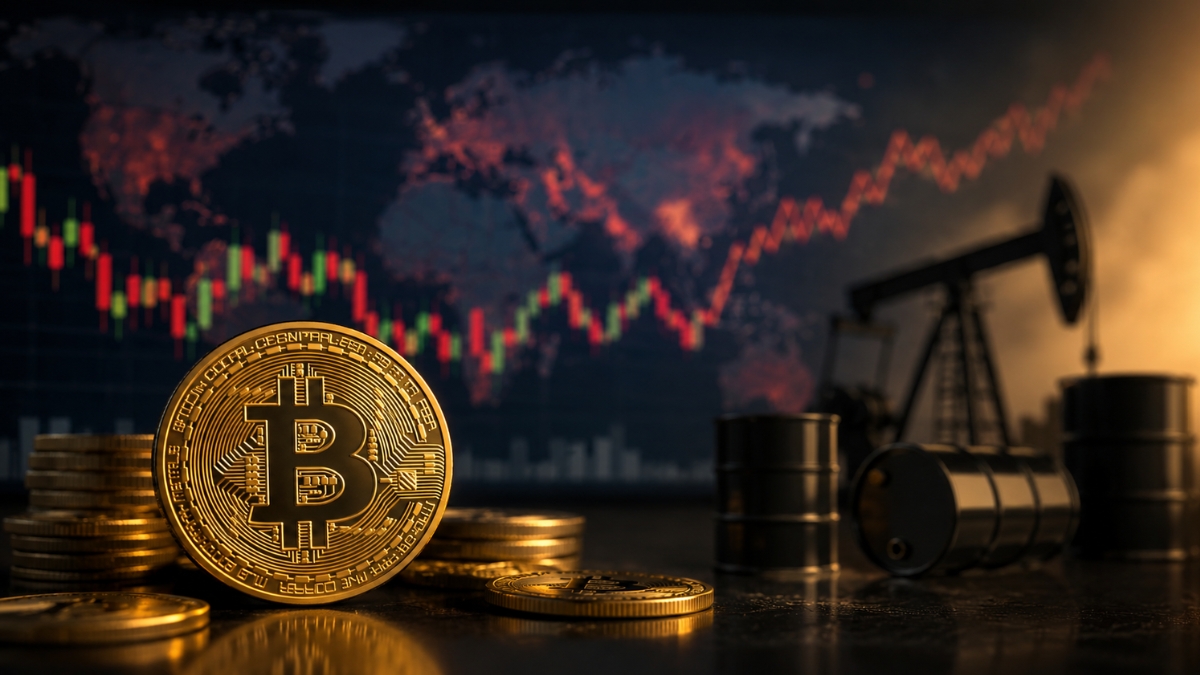
Bitcoin is hovering around the $77,000 mark, but the bigger story isn’t just about whether it can cross $78,000.
What’s really driving Bitcoin right now? Oil prices, geopolitical tensions, interest rates and investor risk appetite. And if you’re an Indian investor who has even a small exposure to crypto, these global factors matter more than you may think.
Bitcoin isn’t moving in isolation anymore
Bitcoin was once seen as an asset operating outside the traditional financial system. Today, its price is increasingly influenced by the same forces that move stocks and other risky assets.
Right now, geopolitical tensions and a sharp rise in crude oil prices are making investors cautious. Brent crude has moved close to $95 a barrel, raising concerns about inflation.
Why does that matter for Bitcoin?
Because if inflation stays high, central banks may have less room to cut interest rates. Higher interest rates can make safer investments more attractive and reduce the appetite for volatile assets such as cryptocurrencies.
So, oil goes up → inflation worries rise → rate-cut hopes weaken → risk appetite can fall → Bitcoin feels the pressure.
The $78,000 question
For now, traders are watching two important levels.
$78,000: A move above this level could signal that Bitcoin is regaining momentum.
Around $76,400: A fall below this zone could indicate further weakness.
But here’s something investors should remember: a price level is not an investment thesis. Bitcoin crossing $78,000 doesn’t automatically mean it is a good time to buy. Similarly, falling below $76,000 doesn’t automatically mean you should sell.
Despite the volatility, investors haven’t completely walked away from crypto.
US spot Bitcoin ETFs have continued to see inflows, suggesting that institutional and other large investors still see long-term potential in Bitcoin.
But this also tells us something important: even large investors can’t completely escape market cycles. Bitcoin can attract billions in institutional money and still experience sharp short-term swings.
So, what does this mean for an Indian investor?
This is where the story gets personal.
If you own Bitcoin or are thinking about investing in it, don’t look at the price alone. Look at your overall portfolio. If most of your money is already in equities, adding a highly volatile asset like crypto can significantly increase the ups and downs you experience.
That’s why crypto, if it forms part of your investment strategy at all, should be viewed as a high-risk allocation rather than the foundation of your financial plan.
Your emergency fund, insurance, debt management and long-term investments don’t depend on Bitcoin crossing $78,000.
Your financial goals shouldn’t either. FOMO can turn into a cycle of buying high and selling low. Instead of trying to predict Bitcoin’s next move, investors should first decide how much volatility they can actually afford to take.
If a 20–30% fall would make you panic and sell, the problem isn’t Bitcoin’s price.
It’s that your allocation may be too high for your risk appetite.
What This Means for Your Money
Bitcoin’s $78,000 target may make for an interesting headline, but your personal-finance question should be different:
“How much of my financial future am I willing to put on an asset that can move this much?” Because you don’t need to predict Bitcoin’s next move to build wealth.
You need a financial plan that can survive it.
Source: MoneyControl



News
World Investor Week 2026: What SEBI and Mutual Fund Companies Are Doing to Make Investing Simpler

From college campuses to awareness campaigns, here’s how the financial industry is trying to help Indians make better money decisions.
Investing can feel confusing when you are just starting out. Should you invest in mutual funds or stocks? How do you know if an investment tip is genuine? And what should you do when the market falls?
This World Investor Week, the focus is on helping people find answers to these questions.
Observed in India from October 5 to 11, World Investor Week 2026 is an initiative aimed at improving investor awareness and protecting people from financial risks. This year’s campaign carries the message “Samajh Se Investing Simple” – making investing simpler through better understanding.
From new awareness campaigns to programmes in colleges and investor education initiatives, here are some of the efforts underway.
1. SEBI’s new campaign wants to make investing easier to understand
On October 5, the Securities and Exchange Board of India (SEBI) launched “Samajh Se Investing Simple” under Project Jagrook.
The campaign aims to help people understand different investment options, the risks involved and how to make informed financial decisions. It also focuses on identifying genuine investment platforms and avoiding financial fraud.
SEBI has also introduced the MUST initiative Mentoring of University/College Students by Trainers to take financial education to campuses. Under this programme, trained faculty members, staff and senior students can help others learn about investing and securities markets.
The regulator has also announced an official WhatsApp channel for sharing investor-awareness information.
Why it matters: You don’t need to become a stock market expert overnight. But understanding the basics, knowing the risks and spotting suspicious investment offers can help you make better decisions with your money.
2. AMFI and Panjab University are bringing financial education to campuses
The Association of Mutual Funds in India (AMFI) has partnered with Panjab University to promote financial literacy and create opportunities for students interested in becoming mutual fund distributors.
The partnership, announced on October 5, covers Punjab, Haryana, Himachal Pradesh and Chandigarh. It will use a Train the Trainer model, where selected faculty members receive training to conduct financial literacy programmes.
Interested students will also be encouraged to pursue the relevant National Institute of Securities Markets (NISM) certification and obtain an AMFI Registration Number (ARN), which is required to distribute mutual funds.
Why it matters: Learning about money shouldn’t begin only after you start earning. Introducing financial education in colleges can help young adults understand investing before they make their first big financial decisions. The partnership also creates a possible career pathway for students interested in mutual fund distribution.
3. PPFAS Mutual Fund is sharing investor education resources
PPFAS Mutual Fund has created a dedicated World Investor Week 2026 page featuring educational videos and links to its investor lessons.
The idea is to give investors access to learning resources that can help them build a better understanding of investing.
Why it matters: If you’re new to investing, educational resources can help you learn at your own pace, understand unfamiliar terms and ask better questions before putting your money into an investment.
4. Investor awareness is also reaching beyond financial classrooms
SEBI’s World Investor Week programme includes investor-awareness activities, educational resources, quizzes and contests. The regulator’s message for investors also highlights an important lesson: market ups and downs are normal, and investors should avoid making rushed decisions in response to volatility.
SEBI Chairman Tuhin Kanta Pandey also addressed the AMFI-Pinkathon Investor Awareness Programme on October 8, under the theme “Every Step Counts – Towards Financial Well-being.”
These initiatives bring investor awareness into different settings, helping make financial education more visible and accessible.
What does this mean for you?
World Investor Week is a reminder that investing isn’t just about finding the next stock or mutual fund that could deliver high returns. It’s also about understanding where your money is going and what risks you’re taking.
Here are a few simple things you can do:
- Understand before you invest: Learn how a product works and what risks come with it.
- Don’t blindly follow tips: Be cautious of guaranteed-return promises and investment advice from unverified sources.
- Stay calm when markets fall: Short-term market movements are normal. Avoid making rushed decisions out of fear.
- Check who you’re dealing with: Verify investment platforms, advisers and payment requests before sharing money or personal details.

From rising poultry feed costs to growing demand for maize, here’s how changes in the energy and agriculture sectors could affect your grocery budget.
Eggs are among the simplest ways to add protein to your daily diet without spending too much. But when their prices rise, even a small increase can add up for households that buy them regularly.
As India celebrates World Egg Day on October 9, 2026, egg prices are also drawing attention to a bigger question: how can changes in industries far removed from our kitchens affect everyday expenses?
A September 2026 report by India Today, citing a LocalCircles survey of more than 67,000 consumer responses across 287 districts, found that 62% of respondents reported egg price increases of 10% to 50% or more over the previous six months.
So, what is driving these increases, and what could they mean for your wallet?
Why are egg prices rising?
1. The maize and ethanol connection
One of the key ingredients in poultry feed is maize, which provides energy to chickens. However, maize is also used to produce ethanol, a biofuel blended with petrol in India.
As demand for ethanol grows, more maize may be directed towards fuel production. This creates competition between industries that need the same agricultural commodity, including poultry farmers who depend on it to feed their birds.
When maize becomes more expensive, the cost of poultry feed can rise. Farmers may then pass on some of these additional expenses through higher egg prices.
2. Rising poultry feed costs
Maize is not the only ingredient used in poultry feed. Soybean meal and other nutrients are also important for poultry health and egg production.
A September 2026 report by India Today noted that poultry feed costs had risen by around 15% year-on-year in July. Higher input costs can squeeze farmers’ margins and contribute to higher prices for consumers.
Weather conditions can add to the pressure. Heat stress can affect poultry productivity, while disease outbreaks and supply disruptions can increase production costs.
3. Could winter make eggs more expensive?
Egg consumption often increases during colder months. If demand rises faster than supply, prices may face additional pressure.
However, further price increases are not guaranteed. Actual prices will depend on feed costs, poultry production, local supply and seasonal demand.
What Does This Mean For Your Monthly Budget?
A small increase in the price of an egg may not seem significant, but regular purchases can make a difference over a month.
For example, if you eat two eggs daily, you consume around 60 eggs in 30 days. If the price per egg rises by ₹2, that means an additional ₹120 a month. For a household consuming four eggs daily, the extra expense would be ₹240.
These are illustrative calculations, not estimates of the current price increase.
The Bigger Picture
India’s ethanol-blending programme aims to reduce dependence on conventional petrol. However, when crops such as maize are used for both fuel and animal feed, changes in demand can affect production costs across industries.
Ethanol production is not the only reason egg prices change. Weather, feed costs, supply and consumer demand all play a role.
This World Egg Day, the takeaway is simple: everyday expenses are connected to the wider economy. Understanding these connections can help you make sense of rising grocery bills and manage your household budget better.

India’s food prices could face fresh pressure as the ongoing Russia-Ukraine conflict disrupts supplies of yellow peas and sunflower oil. Both commodities are important to India’s food market, and any increase in their import costs can affect prices across the supply chain.
According to a report in The Economic Times, uncertainty around shipments from the Black Sea region has raised concerns about the availability and cost of these products in India.
Why Are Yellow Peas and Sunflower Oil in Focus?
Russia and Ukraine are important suppliers of agricultural commodities to global markets. The conflict has affected trade routes, shipping schedules and the movement of goods from the region.
Sunflower oil is particularly relevant for India, which depends heavily on imports to meet its edible oil requirements. When supplies become uncertain or shipments are delayed, importers may have to pay more to source the commodity from alternative markets.
Yellow peas, meanwhile, are used in food products and as a source of protein. Changes in their availability and import costs can affect traders, food manufacturers and businesses that use them as ingredients.
How Can the Conflict Affect Prices in India?
The impact is not limited to the cost of importing a commodity. Higher shipping costs, supply delays and the need to find alternative suppliers can all add to the final price.
If importers pay more to bring these products into India, some of that increase could eventually be passed on to wholesalers, retailers and consumers. However, the extent of the impact will depend on how long supply disruptions continue, the availability of alternatives and domestic market conditions.
For sunflower oil, higher prices could put pressure on household grocery budgets. For yellow peas, the impact could be felt through the cost of the commodity itself and products that use it.
Will Your Grocery Bill Go Up?
For households, the key concern is whether higher import costs translate into more expensive everyday essentials.
Edible oil is a regular kitchen purchase, so even a small increase in its price can add to monthly grocery expenses over time. Consumers may also notice price changes in packaged foods and other products that use imported agricultural ingredients.
However, a rise in global prices does not automatically mean an immediate or equal increase in retail prices across India. Existing inventories, domestic supply, taxes and competition between sellers can influence how quickly international price changes reach consumers.
From Global Markets to Your Kitchen
The Russia-Ukraine conflict is another reminder of how global events can affect household budgets in India. When a country relies on imports for essential commodities, disruptions thousands of kilometres away can eventually influence prices at the local grocery store.
For now, the extent of the impact on Indian consumers will depend on how supplies, shipping and global commodity prices evolve.
-
 Podcast1 year ago
Nitin Jain: From IIT to Investment Titan, Managing ₹60,000 Crore AUM
-

 Explainer4 months ago
How Much SIP Do You Need to Build ₹1 Crore? The Power of Time and Compounding
-
 News3 weeks ago
NSE Makes Long-Awaited Market Debut After ₹22,562-Crore IPO
-
 News2 weeks ago
SC Says No Stay On New UPI Charges Above ₹2,000
-
 Podcast1 year ago
From ₹1 Lakh Lost to Managing ₹650 Crore: How Divam Sharma of Green Portfolio Built a Fundamental Investing Approach
-

 Podcast4 months ago
Can ₹200 SIPs Create India’s Next Investing Revolution? Ravi Kumar Jha’s Big Bet On Financial Inclusion
-
 Podcast1 year ago
From ₹1 Lakh Lost to Managing ₹650 Crore: How Divam Sharma of Green Portfolio Built a Fundamental Investing Approach
-
 News3 weeks ago
Will Your Phone’s Tempered Glass Get More Expensive From 2027?