
Economy
GST Collections Rise 15% YoY to Nearly Rs 2 Lakh Crore in August

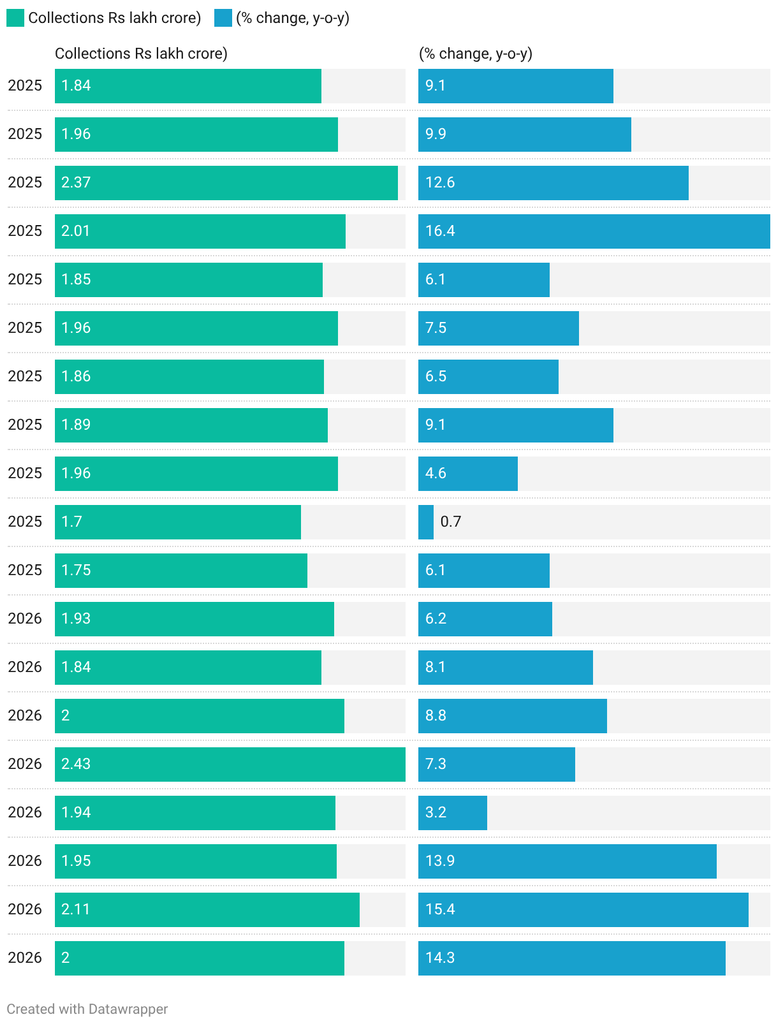
India’s gross Goods and Services Tax (GST) collections rose 15% year-on-year (YoY) to nearly Rs 2 lakh crore in August, extending a period of strong revenue growth, according to government data released on September 1. Gross GST collections stood at Rs 1.998 lakh crore in August, compared with Rs 1.74 lakh crore in the same month last year. The latest increase follows 15.4% growth in July and 13.9% in June, marking the third consecutive month of double-digit growth.
Import Revenues Drive Growth
The rise in August collections was led largely by GST revenue from imports.
Import-related gross GST revenue increased 29% to Rs 62,604 crore in August from Rs 48,546 crore a year earlier. In comparison, domestic GST revenue grew 9.3% to Rs 1.37 lakh crore from Rs 1.26 lakh crore.
The stronger growth in import-related collections provided a significant boost to the overall GST revenue figure during the month.
Higher Refunds Moderate Net Collections
While gross collections remained strong, net GST revenue grew at a slower pace because of a sharp increase in refunds.
Total refunds rose 67.9% to Rs 31,795 crore in August from Rs 18,935 crore a year earlier. Domestic refunds increased 72.6%, while export GST refunds processed through ICEGATE rose 61.8%.
After accounting for refunds, net GST collections increased 8.3% to Rs 1.68 lakh crore, compared with Rs 1.55 lakh crore in August 2025.
Net domestic GST revenue grew 3.4% to Rs 1.19 lakh crore, while net customs GST collections rose 22.3% to Rs 49,299 crore.
GST Collections Rise 11% in FY27 So Far
For the April-August period of FY27, gross GST collections increased 11% to Rs 10.43 lakh crore, compared with Rs 9.40 lakh crore during the corresponding period last year.
Domestic gross GST revenue grew 5.3% during the first five months of the financial year, while revenue from imports increased 27.3%.
Net GST collections rose 9% to Rs 8.90 lakh crore during April-August. Cumulative refunds during the period increased 23.8% to Rs 1.53 lakh crore.
State-Level Performance Varies
GST collection growth remained uneven across major states in August.
Uttar Pradesh recorded 19% growth in domestic GST collections, followed by Telangana at 16% and Gujarat at 15%. Karnataka and Kerala recorded 13% growth each, while Haryana and Punjab reported 12% growth.
Maharashtra, the country’s largest contributor, recorded an 8% increase in collections to Rs 28,779 crore.
Some states reported declines. Tamil Nadu’s collections fell 1%, while Odisha and Andhra Pradesh recorded 7% declines each. Rajasthan and Goa saw collections fall 2%.
Assam recorded a sharp 162% increase in GST collections during the month.
What the Numbers Show
The August data points to continued strength in India’s overall tax revenue, but the composition of growth is important. Import-related GST collections grew much faster than domestic revenues, while the sharp increase in refunds moderated the rise in net collections.
The sustained growth in gross GST revenue through the first five months of FY27 provides a positive signal for government tax receipts. However, the relatively slower growth in net collections highlights the impact of rising refunds on the revenue available after adjustments.
Source: Moneycontrol







India’s insurance sector could see slower growth in the July–September quarter as companies deal with weaker sales, higher claims and uncertainty over proposed regulatory changes.
Analysts expect life insurers to face pressure on new policy sales and profit margins, while general insurers are dealing with intense competition and higher claims linked to monsoon-related damage. Investors are also watching proposed changes by the Insurance Regulatory and Development Authority of India (IRDAI), which could change how insurance companies pay commissions and manage their expenses.
Life Insurance Sales May Grow Slowly
Life insurance companies are expected to report moderate growth in new business during the quarter. Demand remains uneven, and insurers are seeing different levels of growth across their sales channels, including banks and agents.
According to estimates cited by brokerage firms, HDFC Life Insurance could see new business sales grow by 9% year-on-year, while SBI Life Insurance could report 11% growth. ICICI Prudential Life Insurance is expected to perform better, with an estimated 18% increase. Axis Max Life Insurance could see growth of around 8%.
However, growth in sales does not automatically translate into higher profits.
Insurers are also dealing with pressure on their value of new business (VNB) margins. This measures the expected profit an insurer will earn from the new policies it sells.
The removal of GST on individual life and health insurance policies has affected insurers’ ability to claim input tax credit on certain business expenses. This means some of the costs that insurers previously recovered through tax credits may now add pressure to their margins.
Higher sales of protection products, such as policies that offer financial protection against death or other covered risks, could help offset some of this pressure.
General Insurers Face Higher Claims
General insurance companies, which offer products such as motor, health and property insurance, are facing a different set of challenges.
Intense competition is pushing insurers to price some commercial and motor insurance products aggressively. At the same time, the absence of an increase in motor third-party insurance premiums for FY27 could limit growth in this segment.
Monsoon-related floods and other natural disasters could also lead to higher claims, affecting profitability.
ICICI Lombard General Insurance is expected to see its gross written premium — the total premium generated from policies before certain deductions — decline by around 1% year-on-year. Its net profit is also expected to fall slightly, according to estimates from Emkay Global Financial Services.
Go Digit General Insurance could face similar pressure on premium growth, alongside higher claims and expenses. The brokerage expects its net profit to decline by around 24% year-on-year.
Health insurers, however, could see stronger premium growth. Star Health and Allied Insurance is expected to report a 19% increase in gross written premiums, supported by continued demand for health coverage. However, seasonal illnesses and hospitalisations remain factors to watch.
Why Are New Insurance Rules in Focus?
Beyond quarterly earnings, insurers and investors are keeping an eye on proposed changes from IRDAI.
The regulator has proposed changes to commission payments and limits on insurers’ expenses. It is also considering restrictions on compulsory insurance bundling with loans.
Insurance companies often rely on banks, agents and other intermediaries to sell policies. These distribution channels can help insurers reach more customers, but the commissions and operating costs involved can also affect profitability.
If the proposed rules change how much insurers can spend on distribution, companies may need to rethink how they sell policies and which channels they depend on.
The changes could also affect banks and online insurance platforms that earn revenue from distributing insurance products. However, the final impact will depend on the rules eventually adopted and how individual companies adjust their business strategies.
More Than Just Selling Policies
India’s insurance sector is dealing with two challenges at once: maintaining business growth while managing costs and claims.
For insurers, the coming quarter will be important in understanding how sales, profitability and expenses are shaping up. Regulatory changes could bring further adjustments to the way policies are distributed.
For customers, the key thing to watch is how these changes translate into policy pricing, product choices and the overall insurance-buying experience. Proposed commission and expense rules do not automatically mean premiums will become cheaper.
Ultimately, the industry’s challenge is not just selling more policies. It is building a sustainable business while making insurance accessible, useful and affordable for more Indians.
The Reserve Bank of India (RBI) has raised the repo rate by 25 basis points, from 5.25% to 5.5%, and shifted its policy stance from neutral to calibrated tightening. The move could affect household finances in different ways. Borrowers with floating-rate loans may face higher borrowing costs, while people investing in fixed deposits could see better rates if banks raise deposit rates. The impact, however, will not be the same for everyone.
What happens to fixed deposit rates?
A repo rate hike does not automatically mean banks will increase FD rates by the same 25 basis points.
According to the source, public and private sector banks currently offer around 5% to 7.65% on deposits with tenures ranging from one to 10 years. Small finance banks offer around 5.75% to 8.25%.
FD rates could rise following the repo rate increase, but the extent will depend on each bank’s funding requirements and competition.
For savers, this means it may be worth comparing rates across banks when opening or renewing an FD rather than assuming every bank will pass on the entire rate hike.
What happens to home loan EMIs?
Home loan borrowers with floating rates linked to external benchmarks such as the repo rate are likely to feel the impact more directly.
For a new borrower, the higher rate could apply immediately. Existing borrowers will generally see the impact when their loan reaches its scheduled reset date.
The effect on the monthly EMI and loan tenure depends on the terms of the individual loan.
For example, if a bank keeps the EMI unchanged, the higher interest cost could result in a longer repayment period. Alternatively, the EMI could increase while the tenure remains similar.
Should existing borrowers prepay?
Borrowers with surplus cash could consider partial prepayment of their loans.
This can reduce the outstanding principal and, consequently, the total interest payable over the remaining loan period.
However, borrowers should not use up their emergency savings simply to prepay a loan.
The source also suggests that borrowers stuck with older MCLR- or base-rate-linked loans, or those whose financial position has improved, could examine refinancing options.
Will new homebuyers be affected?
Higher interest rates can reduce the amount a person may be eligible to borrow because lenders assess affordability using factors such as the borrower’s fixed obligations and income.
That does not necessarily mean a financially prepared buyer needs to postpone a home purchase solely because of one rate hike.
Home loans are long-term commitments and interest rates can move through several cycles during the repayment period.
The more important question is whether the borrower can comfortably manage the EMI even if rates rise further.
What about car and personal loans?
Borrowers with floating-rate car or personal loans linked to external benchmarks could also see higher borrowing costs.
For new borrowers, the key question is whether the EMI remains affordable if interest rates rise further.
Those with adequate savings could consider making a higher down payment on a new vehicle or loan to reduce the amount borrowed and lower the overall interest cost.
Existing borrowers should first check whether their loan carries a fixed or floating interest rate and understand when the next reset will happen.
Part-prepayment may also be an option for borrowers with sufficient surplus funds.
What happens to debt mutual funds?
The impact of a repo rate hike is different for debt mutual funds.
Funds with longer duration tend to be more sensitive to changes in interest rates. When rates rise, the prices of existing bonds can come under pressure, which can affect the net asset value of these funds.
The source notes that longer-duration funds may see some near-term impact because the expected rate hike has already been factored into the market to some extent.
During a rate-hike cycle, lower-duration funds may therefore be more suitable for investors who want to limit interest-rate sensitivity.
Should investors buy long-duration funds now?
The source suggests that investors comfortable with volatility and duration risk could make small tactical allocations to gilt and duration funds.
However, a broader shift towards longer-duration funds may be more appropriate after a few rate hikes, when there is greater clarity that the tightening cycle will not become steep.
Investors looking at target-maturity funds could also consider them if the yield to maturity is attractive and their investment horizon matches the fund’s maturity.
The common-man takeaway
The repo rate hike can have different effects depending on where your money is.
If you have a loan: your borrowing cost could rise, particularly if the loan is floating-rate and linked to an external benchmark.
If you have an FD: banks may increase deposit rates, although there is no guarantee that rates will rise by the full 25 basis points.
If you are planning to borrow: check whether the EMI remains comfortable even if rates rise further.
If you invest in debt funds: remember that longer-duration funds generally carry greater interest-rate sensitivity.
The key is not to react to the rate hike in isolation. Borrowers should focus on repayment capacity, while investors should match their choice of deposits or debt funds with their time horizon and risk tolerance.

India’s gross GST collections crossed Rs 2 trillion in September, while net collections rose 18.1% after refunds. Gross Goods and Services Tax (GST) collections rose 14.7% year-on-year to over Rs 2.03 trillion in September, according to data reported by the Press Trust of India. The latest numbers show continued growth in GST revenue, with both domestic activity and imports contributing to the increase.
Domestic GST revenue rises 10.1%
GST revenue from domestic activities rose 10.1% to around Rs 1.38 trillion in September.
This reflects the tax collected from economic activity within the country.
Revenue from imports recorded a sharper increase, rising 26% to Rs 65,525 crore.
The stronger growth in import-related GST helped push total gross collections higher during the month.
Net GST collections rise 18.1%
The government also issued GST refunds during September.
Refunds stood at Rs 27,001 crore, down 3% compared with the same month last year.
After accounting for these refunds, net GST collections increased 18.1% to more than Rs 1.76 trillion.
The higher growth in net collections compared with gross collections is partly linked to the decline in refunds during the month.
Gross vs net GST collections
Gross GST collection is the total tax collected before refunds are deducted.
Net GST collection is the amount remaining after the government accounts for refunds issued to eligible taxpayers.
For September, the difference was more than Rs 27,000 crore, reflecting the refunds issued during the month.
GST collections in the first half of FY27
The September numbers also take the government’s GST collections for the first six months of the financial year into account.
Between April and September, gross GST collections increased 11.6% to more than Rs 12.46 trillion.
Net GST collections during the same period rose 10.4% to more than Rs 10.66 trillion.
This means the government collected over Rs 12.46 trillion in gross GST revenue during the first half of FY27, while more than Rs 10.66 trillion remained after refunds.
What does the GST increase mean for the economy?
GST collections are closely watched as an indicator of tax revenue and economic activity.
The September data shows that domestic GST revenue continued to grow, while import-related collections recorded a faster increase.
However, GST collections alone do not provide a complete picture of economic growth. They are influenced by factors such as consumption, imports, tax compliance and changes in the tax system.
For the government, higher collections provide greater tax revenue. For consumers and businesses, the figures indicate the scale of GST being collected across economic transactions, but they do not by themselves mean that individual tax rates have increased.
The September figures therefore point to stronger GST revenue collection, with gross collections up 14.7% and net collections up 18.1% after refunds.
-
 News4 weeks ago
SC Says No Stay On New UPI Charges Above ₹2,000
-
 Podcast1 year ago
Nitin Jain: From IIT to Investment Titan, Managing ₹60,000 Crore AUM
-
 News1 month ago
NSE Makes Long-Awaited Market Debut After ₹22,562-Crore IPO
-

 Explainer5 months ago
How Much SIP Do You Need to Build ₹1 Crore? The Power of Time and Compounding
-
 Podcast2 years ago
From ₹1 Lakh Lost to Managing ₹650 Crore: How Divam Sharma of Green Portfolio Built a Fundamental Investing Approach
-

 Podcast4 months ago
Can ₹200 SIPs Create India’s Next Investing Revolution? Ravi Kumar Jha’s Big Bet On Financial Inclusion
-
 Podcast1 year ago
From ₹1 Lakh Lost to Managing ₹650 Crore: How Divam Sharma of Green Portfolio Built a Fundamental Investing Approach
-
 News2 weeks ago
UPI Charges on Payments Above ₹2,000 Delayed Until After Diwali