
Explainer
Money Lessons Are Entering Indian Classrooms. Here’s Why That’s Important


From budgeting pocket money to understanding taxes, savings and mutual funds, financial literacy is slowly becoming part of what Indian students learn in school.
Managing money is a life skill, but for many people, understanding how to save, budget or make informed financial decisions comes much later in life. That could begin to change as financial education finds a place in India’s school curriculum.
The revised NCERT Class IX Social Science textbook, Understanding Society: India and Beyond – Part 2, introduces students to concepts of personal finance, taxation and entrepreneurship. The idea is to familiarise young learners with money management at an early age, rather than leaving them to figure it out as adults.
From Pocket Money to Personal Finance
The new lessons introduce students to several everyday financial concepts, including budgeting, planning expenses, setting savings goals and distinguishing between needs and wants.
Students are also introduced to financial products and concepts such as fixed deposits, mutual funds, Equated Monthly Instalments (EMIs), taxes, investment risks and returns. For the first time, they also get an introduction to personal income tax, including tax slabs under the new tax regime.
These lessons are already translating into small changes in how some students approach money.
At Delhi Public School in Varanasi, for instance, Class IX students have started tracking their daily expenses and identifying the difference between essential and non-essential purchases.
Some are consciously setting aside a portion of their pocket money as savings, while others are cutting down on unnecessary canteen visits. One student even managed to save enough towards buying a gaming console by reducing everyday spending.
Beyond Saving: Understanding How Businesses Work
The financial education lessons go beyond personal money management. The revised curriculum also introduces students to entrepreneurship and the basics of running a business.
Concepts such as profit and loss, accounting, business planning, innovation and risk-taking help students understand how businesses operate and how financial decisions influence them.
This is particularly relevant in a world where children are increasingly exposed to conversations around startups, businesses, investing and the economy.
Why Financial Education Needs to Start Early
Introducing financial concepts during the school years can help children build a stronger foundation for managing money independently.
Understanding the difference between saving and spending, knowing how taxes work and recognising the risks associated with financial decisions are skills that become increasingly important as individuals grow older.
Financial literacy is not just about knowing where to invest money. It is also about developing discipline, planning ahead and making responsible financial choices.
By bringing these subjects into classrooms, schools can give students an opportunity to connect what they learn in textbooks with decisions they will eventually make in real life.
After all, understanding money should not begin with your first salary. It can begin with your first pocket-money budget.
Source : Times of India



Gold has long been considered a safe-haven investment, especially during periods of economic uncertainty. But even gold isn’t immune to market corrections.
After hitting record highs in January 2026, gold prices have witnessed a sharp reversal. On November 20, spot gold fell to $3,585.92 per ounce, nearly 36% below its January peak of $5,594.82.
The decline has brought gold prices to their lowest levels since September 2025 and raised an important question for investors: Is this the right time to buy gold, or could prices fall further?
Interestingly, despite the correction, Goldman Sachs continues to maintain a positive long-term outlook, forecasting gold prices to reach $4,650 per ounce by the end of 2027.
Let’s understand what’s driving the fall and what investors should make of it.
Why Are Gold Prices Falling?
Gold’s recent decline can be linked to a combination of global economic factors, particularly expectations around US interest rates and the strength of the dollar.
1. Higher US interest rates
Gold does not generate regular income like bonds or fixed deposits. When interest rates rise, interest-bearing investments become more attractive, reducing the appeal of holding gold.
Markets have been anticipating further interest rate hikes by the US Federal Reserve, putting pressure on gold prices.
2. A Stronger US Dollar
Gold is internationally traded in US dollars. When the dollar strengthens, gold becomes more expensive for buyers using other currencies, which can affect global demand.
3. Investors Selling Gold to Raise Cash
The recent sell-off in technology and AI-related stocks has also contributed to gold’s weakness. Some investors have reportedly sold their gold holdings to raise cash and cover losses in other investments.
Together, these factors have weighed on gold, reversing much of the rally seen earlier this year.
Goldman Sachs Still Sees Gold at $4,650 by 2027
Despite the sharp correction, Goldman Sachs remains optimistic about gold’s longer-term prospects.
The investment bank has revised its end-2027 gold price forecast to $4,650 per ounce, from its earlier estimate of $4,800.
One of the key reasons behind this outlook is continued buying by central banks.
Goldman expects central banks, including China’s central bank, to remain important buyers of gold. Such purchases can provide long-term support to prices.
The bank also expects private investor demand to recover when the US Federal Reserve begins cutting interest rates towards the end of 2027.
However, the near-term outlook remains challenging, as higher interest rates could continue to limit investor demand.
Central Banks Are Still Buying Gold
While individual investors have become more cautious, central banks continue to add gold to their reserves.
According to the World Gold Council, central banks purchased 675 tonnes of gold between January and September 2026, a 6% increase compared with the same period last year.
Purchases in the third quarter alone stood at 321 tonnes, up 42% year-on-year.
Investment demand has also shown some interesting trends.
- Global physically backed gold ETFs attracted 211 tonnes of inflows in the third quarter of 2026.
- Total global gold ETF holdings reached a record 4,256 tonnes.
- In contrast, demand for physical gold bars and coins fell 19% year-on-year to 268 tonnes during the quarter.
This suggests that institutional and financial investors continue to show interest in gold, even as demand from individual buyers for physical gold has weakened.
Interestingly, lower prices have also started attracting buyers in major gold markets such as India and China.
Should You Buy Gold After the Correction?
A 36% fall from its peak may make gold look attractive. However, a falling price does not automatically mean an investment has become cheap.
Gold’s recovery will depend on several factors, including the US Federal Reserve’s interest rate decisions, the movement of the dollar, central-bank purchases and the return of private investor demand.
For individual investors, the decision should depend on why they want to own gold in the first place.
Gold can play a role in portfolio diversification, but it should not be treated as a guaranteed way to make short-term gains.
Rather than trying to predict the exact bottom, investors looking to build gold exposure could consider spreading their purchases over time. This helps reduce the risk of investing the entire amount at one price.
It is also important to remember that international gold prices quoted in dollars do not directly translate into Indian retail gold rates. Currency movements, import duties, taxes and other local costs influence the final price in India.
The Simple Hai Take:
Gold’s recent correction is a reminder that even traditionally safe-haven assets can experience sharp price swings. While central-bank buying and expectations of lower interest rates could support a recovery, uncertainty remains.
For investors, the bigger question isn’t simply whether gold will rise again. It is how much gold belongs in their portfolio and whether that allocation fits their financial goals.
Sources: The Economic Times
Explainer
From Borrowing ₹5 Lakh to Building a ₹5,000 Crore Business: The Story of Angel One’s Dinesh Thakkar

One newspaper headline, a ₹4 lakh loss and a decision to never give up. Dinesh Thakkar’s journey from an unfamiliar stock market to building one of India’s leading stockbroking companies is a story of risk, resilience and spotting opportunities where others didn’t.
Sometimes, a business journey begins with a plan. Sometimes, all it takes is one newspaper headline.
For Dinesh Thakkar, Chairman and Managing Director of Angel One, it was a headline that read, “Become a millionaire in the stock exchange.”
There was just one problem. He didn’t even know what a stock exchange was!
Growing up in Mulund, Mumbai, in a family involved in the textile business, Dinesh had always wanted to build something of his own. The headline caught his attention, and he turned to his cousin to understand what the stock market was all about.
When he learnt that it involved investing in companies and making money through their growth, he saw an opportunity. Perhaps, he thought, the stock market could help him earn enough to start his own business.
And so, in 1988, he borrowed around ₹5 lakh from friends and relatives and entered the market.
A Costly First Lesson in the Stock Market
His initial trades were profitable, but success came with a little too much confidence. A sudden market crash wiped out nearly ₹4 lakh of the borrowed money.
Afraid of telling his family, Dinesh kept the loss to himself. But instead of walking away, he decided to earn the money back from the same market.
This time, he started studying the market more seriously. As he spent more time understanding how it worked, he noticed a gap in the industry.
Retail investors were not getting the kind of attention and service they needed from traditional brokers.
For Dinesh, this was more than just a problem. It was a business opportunity.
From a Small Dalal Street Office to 300 Clients
He rented a small office on Dalal Street, brought in two partners and started working as a sub-broker.
Getting clients wasn’t easy. He would wait around paan shops where brokers gathered after market hours, hoping to build connections and find business.
But he also understood that attracting customers required something more than just offering brokerage services.
He introduced the use of walkie-talkies to provide customers with quick confirmation of their trades. At a time when technology was not easily accessible, this simple idea made a difference.
His focus on customer service paid off. Within just three months, he had built a client base of around 300 people.
However, another major challenge was waiting around the corner.
The Harshad Mehta Scam: A ₹1.5 Crore Test of Integrity
In 1992, the Harshad Mehta securities scam shook India’s stock market. The crisis affected investors and brokers across the industry, and Dinesh’s clients suffered heavy losses.
Many refused to pay him what they owed. Larger brokers simply declared themselves defaulters and walked away from their commitments.
Dinesh had a choice: do the same or take responsibility.
He chose the latter.
He borrowed nearly ₹1.5 crore to honour his commitments and keep his business running. It was a massive financial burden, but he was determined to rebuild what he had started.
Slowly, he worked his way back.
In 1996, he took another big step and established his own company, Angel. The name reflected the idea that customers should always feel the company was there to support them.
When a Failed Technology Bet Became an Opportunity
Building a business also meant learning to adapt.
Dinesh once invested heavily in an online trading platform, expecting it to transform his business. But the plan did not work out, leaving him with expensive equipment and a failed investment.
Instead of letting the equipment go to waste, he found another use for it. He offered brokers in other cities access to the technology, allowing them to trade at a much lower cost.
It was another example of how a setback could turn into an opportunity.
As India’s financial markets evolved and technology changed the way people invested, Angel also transformed. What started as a small brokerage business gradually grew into a digital-first stockbroking platform.
The company went public in 2020 and rebranded as Angel One in 2021.
From One Newspaper Headline to Millions of Investors
Today, Angel One has grown into one of India’s leading stockbroking companies, serving nearly 4 crore clients and reporting annual revenue of over ₹5,000 crore in the previous financial year, according to the figures shared in the original account.
Think about where it all began.
A young man who didn’t know what a stock exchange was borrowed ₹5 lakh to try his luck in the market. He lost money, took on massive debt, faced failed business bets and still found ways to keep moving forward.
But perhaps the biggest lesson from Dinesh Thakkar’s journey is not just about taking risks.
It is about understanding the market, recognising what customers need, taking responsibility when things go wrong and knowing when to turn a setback into a new opportunity.
Source: Based on the story of Dinesh Thakkar shared via Humans of Bombay.
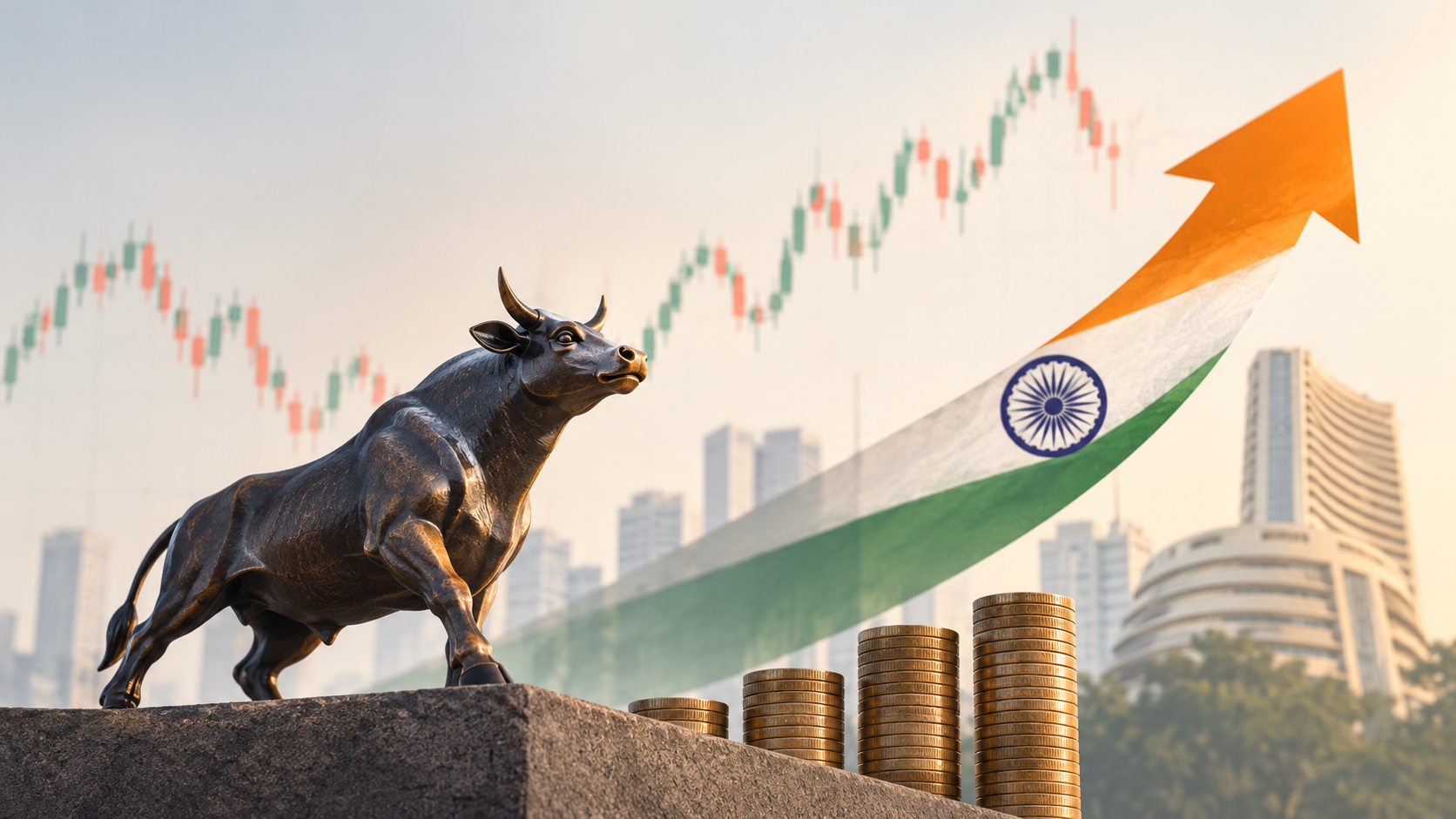
In the Ramayana, when Hanuman was unsure of his abilities, it was Jambavan who reminded him of the strength he already possessed. Sometimes, all it takes is a reminder to recognise what has been there all along.
Something similar could be happening in India’s stock market.
Indian equities have been dealing with a difficult phase. Global conflicts, foreign investor exits, expensive crude oil and uncertainty around global interest rates have weighed on market sentiment. With so much happening around the world, investors have had plenty of reasons to be cautious.
But here’s an interesting question: while the markets are busy reacting to global developments, are they overlooking India’s own economic strengths?
In its investor letter titled State of Indian Markets: Jambavan Moment, Carnelian Capital draws on this mythological reference to explain why India’s underlying growth story may deserve more attention than the current market mood suggests.
When Market Sentiment Forgets the Bigger Picture
Samvat 2082 was not particularly rewarding for Indian equity investors. The Nifty ended the period down approximately 2.6%, reflecting the pressure from several domestic and international developments.
The conflict in West Asia, uncertainty around US trade policies, rising crude oil prices and higher US bond yields created an uncomfortable environment for investors.
There was also a shift in global investment preferences. With technology and artificial intelligence-related opportunities attracting attention in markets such as South Korea and Taiwan, India saw some foreign capital move elsewhere. Its weight in the MSCI Emerging Markets Index also declined.
All of this added to the selling pressure.
However, it is important to separate what is happening in global markets from what is happening within India’s economy. A fall in investor confidence does not necessarily mean that the country’s economic fundamentals have weakened.
And this is where the Jambavan analogy becomes interesting.
India’s Growth Story Has Not Disappeared
While stock market sentiment remained subdued, several indicators suggested that India’s domestic economy was continuing to move forward.
Credit growth averaged approximately 16% during Samvat 2082, compared with around 10% in the previous year. This points towards increased borrowing activity by households and businesses, supporting consumption and investment.
Consumption also received a boost following the introduction of GST 2.0 in September 2025. Lower tax rates across several product categories helped improve affordability, while vehicle sales and festive demand showed encouraging momentum.
The broader economic numbers were equally interesting. India’s GDP grew by approximately 7.6–7.8% in FY26, while growth in the first quarter of FY27 stood at 7.8%, as cited in Carnelian’s analysis.
Corporate performance also offered reasons to remain optimistic. Among 392 Nifty 500 companies that had announced their results, revenue reportedly increased by 24%, while profits grew by 21% year-on-year.
These numbers suggest that the economy and corporate India may be doing better than what the market’s mood currently indicates.
Foreign Investors Are Leaving, But Who Is Holding the Fort?
One of the biggest pressures on Indian equities has been foreign investor selling.
Foreign Institutional Investors (FIIs) reportedly sold close to ₹4 lakh crore worth of Indian equities during Samvat 2082. Higher global interest rates, attractive investment opportunities elsewhere and changing global preferences contributed to this outflow.
But there was another side to the story.
Domestic Institutional Investors (DIIs) invested approximately ₹7.1 lakh crore in Indian equities during the same period. Their investments were almost twice the amount sold by foreign investors.
This reflects how domestic investors and institutions are becoming an increasingly important part of India’s market ecosystem.
In other words, while foreign money may be moving out, domestic participation is helping provide support to the market.
Have We Seen This Story Before?
Market uncertainty is not new, and Carnelian draws attention to the events of 2022 as a useful comparison.
The Russia-Ukraine war, rising oil prices and foreign investor withdrawals created significant pressure on Indian equities. At one point, the Nifty had fallen nearly 17% from its peak.
Yet, the market eventually found its footing. Domestic institutions helped absorb the selling pressure, and the Nifty went on to deliver returns of approximately 19% in 2023 and 9% in 2024.
While history does not guarantee that markets will follow the same path again, it does show that difficult market phases do not always signal a broken economic story.
Sometimes, markets take time to catch up with the underlying reality.
What Lies Ahead for Indian Investors?
Carnelian believes India’s longer-term growth prospects remain encouraging over the next two to three years.
A combination of stronger consumption, healthy credit growth, improving private investment and better corporate earnings could support the next phase of India’s economic expansion.
Valuations have also become relatively more comfortable. The Nifty 50’s one-year forward price-to-earnings (P/E) ratio has reportedly moved down from around 24 times to 19 times. Similarly, the Nifty 500’s valuation has declined from approximately 26 times to 21 times.
Of course, this does not mean that the road ahead will be smooth. Geopolitical tensions, oil prices, global supply-chain disruptions and interest rate movements could continue to influence markets.
But for long-term investors, there is an important distinction between temporary market uncertainty and a change in the country’s growth fundamentals.
Sometimes, All It Takes Is a Reminder
Remember Hanuman’s journey in the Ramayana? His strength was always there, but he needed Jambavan to remind him of what he was capable of.
Carnelian’s Jambavan Moment draws on a similar idea for Indian markets. The country’s economic strengths, domestic consumption, growing credit demand and corporate opportunities have not suddenly disappeared because stock prices are under pressure.
For investors, the lesson is not to ignore market risks or assume that every dip is a buying opportunity. It is to look beyond daily market movements, understand the fundamentals and avoid making long-term decisions based entirely on short-term sentiment.
After all, markets can sometimes lose sight of the bigger picture. And perhaps, like Hanuman, they just need a little reminder of the strength they already have.
Source: Carnelian Capital – State of Indian Markets: Jambavan Moment.
-
 News2 months ago
SC Says No Stay On New UPI Charges Above ₹2,000
-
 Podcast1 year ago
Nitin Jain: From IIT to Investment Titan, Managing ₹60,000 Crore AUM
-
 News2 months ago
NSE Makes Long-Awaited Market Debut After ₹22,562-Crore IPO
-

 Explainer6 months ago
How Much SIP Do You Need to Build ₹1 Crore? The Power of Time and Compounding
-
 Podcast2 years ago
From ₹1 Lakh Lost to Managing ₹650 Crore: How Divam Sharma of Green Portfolio Built a Fundamental Investing Approach
-
 Podcast5 months ago
Can ₹200 SIPs Create India’s Next Investing Revolution? Ravi Kumar Jha’s Big Bet On Financial Inclusion
-
 News1 month ago
UPI Charges on Payments Above ₹2,000 Delayed Until After Diwali
-
 IPO Watch1 month ago
Jio IPO 2026: How the ₹30,213 Crore Issue Will Use Its Funds