
News
Bitcoin Is Stuck at $77,000. Should Indian Investors Care?


Bitcoin is hovering around the $77,000 mark, but the bigger story isn’t just about whether it can cross $78,000.
What’s really driving Bitcoin right now? Oil prices, geopolitical tensions, interest rates and investor risk appetite. And if you’re an Indian investor who has even a small exposure to crypto, these global factors matter more than you may think.
Bitcoin isn’t moving in isolation anymore
Bitcoin was once seen as an asset operating outside the traditional financial system. Today, its price is increasingly influenced by the same forces that move stocks and other risky assets.
Right now, geopolitical tensions and a sharp rise in crude oil prices are making investors cautious. Brent crude has moved close to $95 a barrel, raising concerns about inflation.
Why does that matter for Bitcoin?
Because if inflation stays high, central banks may have less room to cut interest rates. Higher interest rates can make safer investments more attractive and reduce the appetite for volatile assets such as cryptocurrencies.
So, oil goes up → inflation worries rise → rate-cut hopes weaken → risk appetite can fall → Bitcoin feels the pressure.
The $78,000 question
For now, traders are watching two important levels.
$78,000: A move above this level could signal that Bitcoin is regaining momentum.
Around $76,400: A fall below this zone could indicate further weakness.
But here’s something investors should remember: a price level is not an investment thesis. Bitcoin crossing $78,000 doesn’t automatically mean it is a good time to buy. Similarly, falling below $76,000 doesn’t automatically mean you should sell.
Despite the volatility, investors haven’t completely walked away from crypto.
US spot Bitcoin ETFs have continued to see inflows, suggesting that institutional and other large investors still see long-term potential in Bitcoin.
But this also tells us something important: even large investors can’t completely escape market cycles. Bitcoin can attract billions in institutional money and still experience sharp short-term swings.
So, what does this mean for an Indian investor?
This is where the story gets personal.
If you own Bitcoin or are thinking about investing in it, don’t look at the price alone. Look at your overall portfolio. If most of your money is already in equities, adding a highly volatile asset like crypto can significantly increase the ups and downs you experience.
That’s why crypto, if it forms part of your investment strategy at all, should be viewed as a high-risk allocation rather than the foundation of your financial plan.
Your emergency fund, insurance, debt management and long-term investments don’t depend on Bitcoin crossing $78,000.
Your financial goals shouldn’t either. FOMO can turn into a cycle of buying high and selling low. Instead of trying to predict Bitcoin’s next move, investors should first decide how much volatility they can actually afford to take.
If a 20–30% fall would make you panic and sell, the problem isn’t Bitcoin’s price.
It’s that your allocation may be too high for your risk appetite.
What This Means for Your Money
Bitcoin’s $78,000 target may make for an interesting headline, but your personal-finance question should be different:
“How much of my financial future am I willing to put on an asset that can move this much?” Because you don’t need to predict Bitcoin’s next move to build wealth.
You need a financial plan that can survive it.
Source: MoneyControl




You may have a house, investments and savings in your name. But have you ever thought about who gets them if you die without a Will?
Most of us assume our property will automatically go to our closest family members. But when there is no Will, the law gets to decide who inherits what.
For Hindu women, the Hindu Succession Act, 1956 lays down the rules for distributing their property when they die without a valid Will.
And sometimes, the answer may be very different from what you expect.
First up: Who gets the property?
If a Hindu woman dies without a Will, her children and husband are generally first in line to inherit her property.
But what happens if she has no children and her husband has already passed away?
That’s where things get interesting.
Your property may not go to your parents
In certain situations, a woman’s property can go to her husband’s legal heirs before it goes to her own parents or family.
For example, imagine a woman whose husband has passed away and who has no children. She owns a house but dies without making a Will.
Her husband had several brothers and sisters. By the time she dies, some of them have also passed away.
So, who gets the house?
Under the succession rules, the property can go to her husband’s surviving brothers and sisters rather than automatically going to her own parents or siblings.
Surprising? Yes. But that’s why the source of the property matters.
One property, different inheritance rules
Here’s the important bit: not all property is treated the same way.
Where the property came from can affect who eventually inherits it.
If a woman inherited property from her parents, different succession rules can apply, and in certain situations it can pass to her father’s heirs.
If she inherited property from her husband or father-in-law, it can, in certain circumstances, pass to her husband’s heirs if she dies without children.
And if it is property she bought herself, the succession rules can be different again.
So, simply saying “my property will go to my family” isn’t always enough.
Why a Will can save a lot of confusion
This is where a Will becomes an important part of financial planning.
A Will lets you decide who gets your assets and property after you’re gone.
Without one, the law decides.
And that can mean uncertainty, paperwork, family disagreements and sometimes lengthy legal proceedings for the people you leave behind.
This applies not just to property, but also to:
- Mutual funds and investments
- Bank accounts and deposits
- Shares
- Jewellery
- Business interests
- Property inherited from parents
- Property inherited from a spouse
Think of a Will as your financial final word
You spend years earning, saving and investing your money.
So why leave the final decision about where it goes to someone else?
A Will isn’t just about passing on a house or bank balance. It’s about making sure your money reaches the people you intended it to.
What This Means for You
Earn it. Build it. Protect it. And when it comes to passing it on, put your wishes in writing.
Because when there’s no Will, your family may not get to decide where your property goes. The law does.
Source: MoneyControl
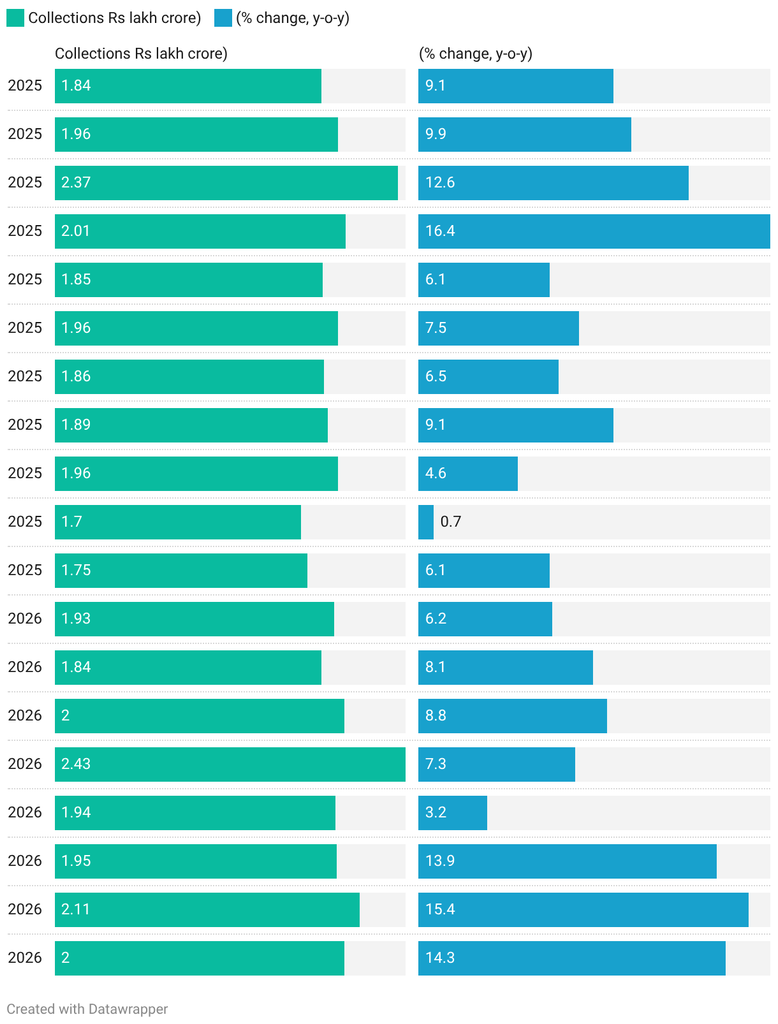
India’s gross Goods and Services Tax (GST) collections rose 15% year-on-year (YoY) to nearly Rs 2 lakh crore in August, extending a period of strong revenue growth, according to government data released on September 1. Gross GST collections stood at Rs 1.998 lakh crore in August, compared with Rs 1.74 lakh crore in the same month last year. The latest increase follows 15.4% growth in July and 13.9% in June, marking the third consecutive month of double-digit growth.
Import Revenues Drive Growth
The rise in August collections was led largely by GST revenue from imports.
Import-related gross GST revenue increased 29% to Rs 62,604 crore in August from Rs 48,546 crore a year earlier. In comparison, domestic GST revenue grew 9.3% to Rs 1.37 lakh crore from Rs 1.26 lakh crore.
The stronger growth in import-related collections provided a significant boost to the overall GST revenue figure during the month.
Higher Refunds Moderate Net Collections
While gross collections remained strong, net GST revenue grew at a slower pace because of a sharp increase in refunds.
Total refunds rose 67.9% to Rs 31,795 crore in August from Rs 18,935 crore a year earlier. Domestic refunds increased 72.6%, while export GST refunds processed through ICEGATE rose 61.8%.
After accounting for refunds, net GST collections increased 8.3% to Rs 1.68 lakh crore, compared with Rs 1.55 lakh crore in August 2025.
Net domestic GST revenue grew 3.4% to Rs 1.19 lakh crore, while net customs GST collections rose 22.3% to Rs 49,299 crore.
GST Collections Rise 11% in FY27 So Far
For the April-August period of FY27, gross GST collections increased 11% to Rs 10.43 lakh crore, compared with Rs 9.40 lakh crore during the corresponding period last year.
Domestic gross GST revenue grew 5.3% during the first five months of the financial year, while revenue from imports increased 27.3%.
Net GST collections rose 9% to Rs 8.90 lakh crore during April-August. Cumulative refunds during the period increased 23.8% to Rs 1.53 lakh crore.
State-Level Performance Varies
GST collection growth remained uneven across major states in August.
Uttar Pradesh recorded 19% growth in domestic GST collections, followed by Telangana at 16% and Gujarat at 15%. Karnataka and Kerala recorded 13% growth each, while Haryana and Punjab reported 12% growth.
Maharashtra, the country’s largest contributor, recorded an 8% increase in collections to Rs 28,779 crore.
Some states reported declines. Tamil Nadu’s collections fell 1%, while Odisha and Andhra Pradesh recorded 7% declines each. Rajasthan and Goa saw collections fall 2%.
Assam recorded a sharp 162% increase in GST collections during the month.
What the Numbers Show
The August data points to continued strength in India’s overall tax revenue, but the composition of growth is important. Import-related GST collections grew much faster than domestic revenues, while the sharp increase in refunds moderated the rise in net collections.
The sustained growth in gross GST revenue through the first five months of FY27 provides a positive signal for government tax receipts. However, the relatively slower growth in net collections highlights the impact of rising refunds on the revenue available after adjustments.
Source: Moneycontrol

The food industry is stepping up its focus on hygiene and food safety as regulatory scrutiny and consumer expectations grow. Restaurants, food delivery platforms and their suppliers are tightening checks across kitchens, ingredients and food-handling processes to ensure that safety standards are followed.
Restaurants Tighten Kitchen Checks
Large restaurant chains are increasingly asking suppliers to meet stricter quality standards and are carrying out more frequent inspections at their outlets. Checks are focusing on ingredients such as meat, buns, ketchup and fresh produce, along with kitchen cleanliness, food segregation and staff hygiene. Restaurants are also investing in employee training and regular hygiene audits to reduce the risk of food safety violations.
Delivery Platforms Face Greater Responsibility
Food delivery platforms are also becoming an important part of the food safety chain. Since customers cannot see how their food is prepared when ordering online, platforms are under growing pressure to ensure that restaurants listed on their apps follow basic hygiene and safety requirements. This has led to greater attention towards restaurant audits, documentation and compliance.
Focus on Ingredients and Transparency
Another major concern is the use of unauthorised ingredients or substitutes that may not be clearly disclosed to customers. Restaurants and food businesses are being encouraged to ensure that the ingredients they use match what is mentioned on their menus and product information. Greater transparency can help businesses avoid regulatory issues while also building consumer trust.
Regulators Push for Stronger Compliance
Food safety authorities are increasing their focus on inspections and compliance across the food supply chain. The aim is to ensure that food safety standards are followed not just by restaurants, but also by suppliers, manufacturers and other businesses involved in getting food to consumers. Better record-keeping, traceability and accountability are becoming increasingly important.
Technology Joins the Food Safety Push
Technology could also play a bigger role in improving food safety. Digital systems can help businesses track suppliers, monitor ingredients, maintain quality records and identify gaps in compliance. For large restaurant chains and delivery platforms, such systems can make it easier to monitor standards across multiple outlets and partners.
What It Means for Consumers
For consumers, the tightening of hygiene checks could mean safer food and greater transparency. As food delivery becomes a regular part of everyday life, customers increasingly expect the same safety standards from delivered food as they do from restaurants they visit in person.
The larger shift is clear: food safety is no longer just about passing an inspection. For restaurants, suppliers and delivery platforms, maintaining consistent hygiene and quality standards is becoming essential to protecting both consumer trust and the business itself.
Source: The Economic Times
-

 Podcast4 months ago
Why NOT Investing Is the Biggest Risk Today | Vetri Subramaniam | Simple Hai!
-

 Explainer3 months ago
How Much SIP Do You Need to Build ₹1 Crore? The Power of Time and Compounding
-
 News3 days ago
ITR Filing Deadline Today: Common Mistakes to Avoid & What Happens If You Miss It
-

 Podcast10 months ago
Making Money Requires Conviction, Not Borrowing: Lessons from Vikas Khemani
-

 Explainer3 weeks ago
What Does Financial Freedom Really Mean? A Simple Guide to Building Wealth
-
 Explainer2 months ago
New EPF Scheme 2026: What Has Actually Changed for Your PF?
-

 Podcast4 weeks ago
Digital Gold Can Unlock India’s $5 Trillion Opportunity, Mahendra Luniya
-

 IPO Watch2 months ago
SBI Funds Management IPO: What You Need to Know