
Explainer
The ₹80,000 Phone: A Status Symbol or a Financial Mistake?


For young earners, buying an expensive smartphone can feel like a reward for hard work. But when does the desire to look successful start getting in the way of building wealth?
The first salary brings a new kind of freedom. A young professional can finally buy things without asking for money. And often, the first big purchase is a smartphone.
Friends are flaunting their latest devices, Instagram is flooded with unboxing videos and a perfectly functional phone suddenly feels outdated. An ₹80,000 smartphone starts looking less like an expense and more like a reward for all the hard work.
But there is a difference between buying something because it adds value and buying it because it makes life look better to others.
India’s premium smartphone obsession
India’s smartphone market is moving towards premium devices. According to Counterpoint Research, smartphones priced above ₹30,000 accounted for 22% of smartphone shipments in India in 2025, their highest ever share.
A July 2026 Counterpoint Research survey also found that 46% of prospective smartphone buyers in India were willing to stretch their budgets to purchase their preferred phone despite price increases. Among consumers aged 25 to 30, the figure was 52%.
These numbers do not mean everyone buys expensive phones for status. Better cameras, performance and software support can justify the premium. However, they highlight how willing consumers can be to spend beyond their original budgets for a device they desire.
For young professionals still building their savings, this creates a dilemma: should the money go towards a premium phone or towards financial security?
What does an ₹80,000 phone actually cost?
Consider someone earning ₹40,000 a month and choosing between a ₹15,000 smartphone and an ₹80,000 device.
The premium phone costs twice their monthly salary before deductions. The budget alternative costs less than half of one month’s salary.
The difference is ₹65,000. That money could help build an emergency fund, pay for professional training or contribute towards future investments.
Of course, a premium phone may offer better features and a longer useful life. The point is not that expensive phones are always a bad purchase. It is whether the additional benefits justify the additional cost.
The EMI trap
Monthly instalments can make an expensive purchase feel manageable. Instead of thinking about ₹80,000, buyers focus on a smaller monthly payment.
But an affordable EMI does not automatically make a purchase financially sensible.
If repayments leave little money for savings, rent or other priorities, the phone may be stretching the budget more than it appears. Interest and fees can also increase the total cost.
The real cost of keeping up
The phone that attracts compliments today may become ordinary tomorrow. A newer model arrives, attention shifts and the excitement fades. The money spent, however, does not return.
For someone whose main motivation is social recognition, this creates an uncomfortable trade off. The owner bears the full cost while the approval may last only a short time.
Choosing a budget phone and keeping the ₹65,000 difference could create room for savings, experiences or investments. For illustration, ₹65,000 invested at an assumed annual return of 10% could grow to approximately ₹1.05 lakh over five years, before taxes and charges. Actual returns are not guaranteed.
So, should young earners buy budget phones?
Not necessarily. A premium phone can be worth the money when its features genuinely matter and the purchase fits comfortably within the buyer’s finances.
But before upgrading, it helps to ask: is the phone being purchased for its usefulness or because everyone else seems to have one?
Affordable smartphones have expanded the choices available to consumers. For everyday needs such as messaging, digital payments, browsing and streaming, a budget device may be sufficient.
A smartphone can signal purchasing power, but it cannot tell anyone how financially secure its owner really is.
The real flex is not owning the most expensive phone. It is being able to afford the things that matter without sacrificing the financial freedom that makes them possible.






A family business can take generations to build. But without clear documentation, deciding who owns what can become a challenge of its own.
India’s business families are increasingly bringing an important question into focus: when wealth is built across generations, how do you ensure it is divided fairly?
The latest developments within the TVS family offer an interesting perspective.
Lakshmi Venu, daughter of TVS Motor chairman emeritus Venu Srinivasan, has formally sought the partition of joint family assets held within her father’s branch of the family. In a notice to her father, she has sought a fair and lawful division, asserting her rights under the Hindu Succession Act, 1956, as amended in 2005.
The assets in question include family interests held through the VS Trust and other holding structures, covering interests in TVS Holdings, TVS Motor Company, TVS Credit Services and Sundaram-Clayton.
At the centre of the issue is a distinction between the larger TVS family arrangement of 2020 and the subsequent arrangements within the Venu Srinivasan family. While the broader family restructuring was implemented, Lakshmi maintains that the economic interests within her immediate family were never formally partitioned. Venu Srinivasan and his son Sudarshan, on the other hand, have maintained that the 2024 family arrangement constitutes a settlement.
The matter highlights an important aspect of succession planning: dividing responsibilities is not necessarily the same as dividing ownership.
Why documentation matters
In family-run businesses, decisions about ownership, management and inheritance can often overlap. One family member may manage a company, another may hold shares, while other assets may sit within trusts or separate holding entities.
Without clear documentation, these arrangements can become difficult to interpret, particularly when the next generation begins taking on larger responsibilities.
A well-documented family settlement can help establish who owns which assets, how shares are distributed, who has management responsibilities and what happens when ownership changes. It can also help distinguish personal wealth from business assets and clarify the role of trusts, holding companies and other structures.
The importance of getting the paperwork right
India’s Hindu Succession Act, particularly Section 6 following the 2005 amendment, recognises daughters as coparceners by birth in Hindu joint families governed by Mitakshara law, giving them the same rights and responsibilities as sons in qualifying coparcenary property.
This makes it important for families to understand the nature of their assets and document their arrangements accordingly. Not every family asset automatically falls under the same inheritance rules. Self-acquired property, ancestral property, company shares and assets held through trusts can involve different legal considerations.
For business families, succession planning is therefore not just about choosing the next leader. It is also about creating clarity around ownership, rights and responsibilities.
Because building an empire may take decades, but ensuring the next generation inherits it without confusion requires planning much earlier.

You spend years building wealth, buying property, investing and creating financial security for your family. But have you decided what happens to it when you are no longer around?
It is a question many people postpone. Making a Will is often associated with old age or enormous fortunes. But estate planning is not just for billionaires. Anyone who owns assets, investments or property can benefit from having one.
And the stories of some of India’s biggest business families show why.
When an empire has no clear instructions
Take the example of Dhirubhai Ambani, the founder of Reliance Industries.
When he passed away in July 2002, he did not leave a Will. His estate was subsequently dealt with through a Deed of Release signed by his wife Kokilaben, sons Mukesh and Anil, and daughters Nina and Dipti. The document recorded that Dhirubhai had died intestate, meaning without leaving a Will.
In the years that followed, differences between Mukesh and Anil over control of the Reliance business became a major corporate story. The family eventually reached a business division in 2005, with Kokilaben playing a key role in the settlement.
While the absence of a Will was not the sole reason for the brothers’ differences, the episode highlighted how complicated wealth distribution and business succession can become without clear arrangements.
Ratan Tata: A Will that reflected personal choices
A very different example emerged after Ratan Tata’s death in October 2024.
His Will attracted considerable attention because of the way he chose to distribute his personal wealth. Reports indicated that a significant portion of his estate was earmarked for charitable causes through the Ratan Tata Endowment Foundation and Trust.
His Will also made provisions for family members, close associates and people who had been part of his personal life. Even his beloved German Shepherd, Tito, was remembered through arrangements for his care.
The Will demonstrated that estate planning is not simply about dividing wealth among immediate family members. It allows individuals to decide which causes, people and responsibilities they want their wealth to support.
It is also important to distinguish between personal inheritance and corporate succession. A Will can distribute assets owned by an individual, but it does not automatically decide who will run an entire business group.
So, what exactly does a Will do?
A Will is a legal document that records how a person wants their assets distributed after their death. It can cover property, bank deposits, investments, shares and other assets owned by the individual.
It allows a person to:
- Decide who inherits what: Specify beneficiaries and the assets they should receive.
- Reduce confusion: Give family members a clear record of the person’s wishes.
- Appoint an executor: Identify someone responsible for carrying out the instructions in the Will.
- Make provisions beyond family: Leave assets to charities, friends or other individuals.
- Plan for dependants: Include arrangements for minor children and other dependants.
What happens if you don’t have a Will?
If someone dies without a valid Will, they are said to have died intestate. Their estate is then distributed according to the succession laws applicable to them.
For example, the Hindu Succession Act governs intestate succession for Hindus, Buddhists, Jains and Sikhs, while other communities may be governed by different personal laws.
This means the distribution may not necessarily reflect what the individual would have wanted.
A little planning today can prevent a lot of confusion tomorrow
Making a Will does not mean you are expecting the worst. It means you are taking responsibility for the wealth you have built and the people who may depend on it.
It is also important to review your Will as your financial circumstances change, keep asset records updated and ensure that the document is properly executed and witnessed under applicable law.
Explainer
India’s Love for Gold vs Economic Reality: What Does Modi’s Appeal Mean for Jewellers This Diwali?

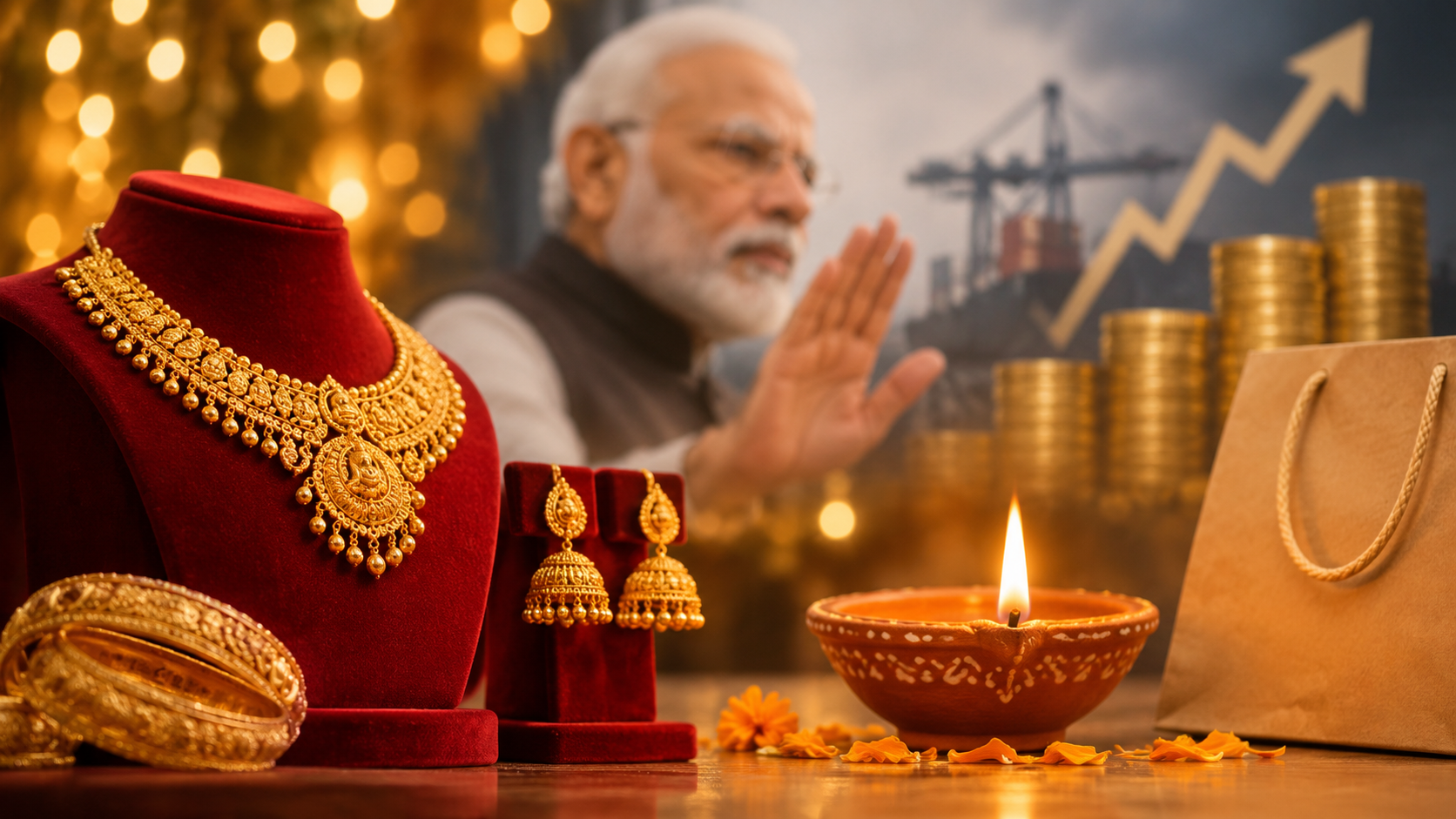
For many Indian households, Diwali is incomplete without gold. Whether it is a small coin bought on Dhanteras, a new piece of jewellery or a wedding purchase, gold has long been associated with prosperity and financial security.
But this festive season, the tradition comes with a question: should Indians rethink their gold purchases?
Prime Minister Narendra Modi’s appeal to citizens to avoid purchasing gold for a year has brought India’s gold-buying habits into the larger economic conversation. The appeal comes amid concerns over rising imports, pressure on foreign exchange reserves and the rupee.
India is one of the world’s largest consumers of gold and depends heavily on imports to meet domestic demand. Reducing unnecessary gold purchases could therefore help ease pressure on the country’s import bill.
However, there is another side to this argument: the jewellery industry.
A Festive Season of Conflicting Signals
For jewellers, Diwali and Dhanteras are among the biggest business opportunities of the year. A slowdown in purchases could affect not just retailers but also manufacturers, artisans, goldsmiths and millions of people employed across the jewellery supply chain.
Industry bodies, including the All India Jewellers and Goldsmith Federation (AIJGF), have raised concerns about the potential impact of discouraging gold purchases. They have also suggested alternatives such as improving gold recycling and bringing household gold into the formal economy.
The concern is understandable. Gold may be an imported commodity, but the jewellery industry built around it is very much domestic.
Are Consumers Really Staying Away From Gold?
Despite the government’s appeal, gold continues to hold its place in Indian households.
According to the World Gold Council’s November 2026 report, India’s gold demand in the September quarter increased 24% sequentially to 162 tonnes. However, it remained 29% lower than the same period last year.
Jewellery demand rose 33% quarter-on-quarter to 100 tonnes, indicating some recovery in festive buying.
Interestingly, consumers are also changing how they purchase gold. Lightweight jewellery, smaller coins and exchanging old jewellery for new pieces are becoming increasingly relevant.
The World Gold Council found that the share of consumers considering exchanging old jewellery to fund new purchases increased from 70% to 76%.
This suggests that people may not necessarily be giving up gold. They are simply becoming more conscious of how much they spend and how much gold they receive in return.
Can India Find a Middle Ground?
The government’s concerns about gold imports are valid. However, reducing consumption is not the only possible solution.
Better gold recycling, stronger monetisation schemes and easier mechanisms to exchange old jewellery could help India make better use of the gold already held by households.
For consumers, the decision to buy gold is often influenced by more than market prices. Weddings, family traditions and long-term savings all play a role.
This makes it difficult to view every gold purchase as unnecessary consumption.
This Diwali, It Is About More Than Buying Gold
The debate is not simply about whether Indians should buy gold this Diwali. It is about balancing economic responsibility with cultural traditions and the livelihoods of an entire industry.
For the government, reducing gold imports is an economic priority. For jewellers, festive demand supports businesses and employment. For households, gold continues to represent both tradition and security.
Perhaps the bigger question is not whether India should stop buying gold, but whether it can become smarter about how it buys, recycles and manages the gold it already owns.
After all, celebrating prosperity and being financially responsible need not be mutually exclusive.
-
 News2 months ago
SC Says No Stay On New UPI Charges Above ₹2,000
-
 Podcast1 year ago
Nitin Jain: From IIT to Investment Titan, Managing ₹60,000 Crore AUM
-
 News2 months ago
NSE Makes Long-Awaited Market Debut After ₹22,562-Crore IPO
-

 Explainer6 months ago
How Much SIP Do You Need to Build ₹1 Crore? The Power of Time and Compounding
-
 Podcast2 years ago
From ₹1 Lakh Lost to Managing ₹650 Crore: How Divam Sharma of Green Portfolio Built a Fundamental Investing Approach
-
 Podcast5 months ago
Can ₹200 SIPs Create India’s Next Investing Revolution? Ravi Kumar Jha’s Big Bet On Financial Inclusion
-
 News1 month ago
UPI Charges on Payments Above ₹2,000 Delayed Until After Diwali
-
 IPO Watch1 month ago
Jio IPO 2026: How the ₹30,213 Crore Issue Will Use Its Funds